Brief Biography of Dan Brown
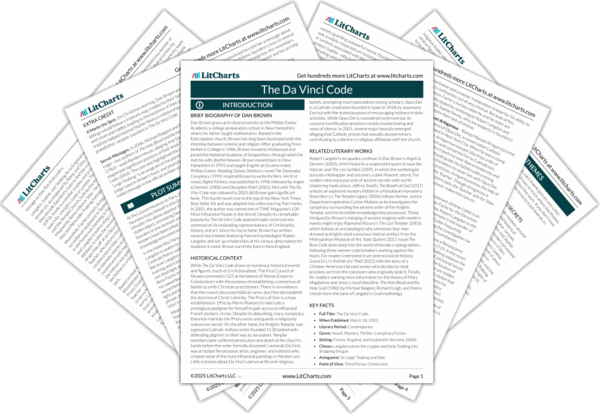
Dan Brown grew up in close proximity to the Phillips Exeter Academy, a college-preparatory school in New Hampshire where his father taught mathematics. Raised in the Episcopalian church, Brown has long been fascinated with the interplay between science and religion. After graduating from Amherst College in 1986, Brown moved to Hollywood and joined the National Academy of Songwriters, through which he met his wife, Blythe Newlon. Brown moved back to New Hampshire in 1993 and taught English at his alma mater, Phillips Exeter. Reading Sidney Sheldon’s novel The Doomsday Conspiracy (1991) inspired Brown to write thrillers. His first novel, Digital Fortress, was published in 1998, followed by Angels & Demons (2000) and Deception Point (2001). Not until The Da Vinci Code was released in 2003 did Brown gain significant fame. This fourth novel rose to the top of the New York Times Best Seller list and was adapted into a film starring Tom Hanks. In 2005, the author was named one of TIME Magazine’s 100 Most Influential People in the World. Despite its remarkable popularity, The Da Vinci Code sparked major controversies centered on its misleading representations of Christianity, history, and art. Since his rise to fame, Brown has written several more books featuring Harvard symbologist Robert Langdon and set up scholarships at his various alma maters for students in need. Brown currently lives in New England.
Historical Context of The Da Vinci Code
While The Da Vinci Code draws on numerous historical events and figures, much of it is fictionalized. The First Council of Nicaea convened in 325 at the behest of Roman Emperor Constantine I with the purpose of establishing a consensus of beliefs to unify Christian practitioners. There is no evidence that the council discussed biblical canon, but they did establish the doctrine of Christ’s divinity. The Priory of Sion is a hoax established in 1956 by Pierre Plantard to fabricate a prestigious pedigree for himself to gain access to influential French esoteric circles. Despite its debunking, many conspiracy theorists maintain the Priory exists and guards a religiously subversive secret. On the other hand, the Knights Templar was a genuine Catholic military order founded 1118 tasked with defending pilgrims on their way to Jerusalem. Templar members later suffered persecution and death at the church’s hands before the order formally dissolved. Leonardo Da Vinci was an Italian Renaissance artist, engineer, and scientist who created some of the most influential paintings in Western art. Little is known about Da Vinci’s personal life and religious beliefs, prompting much speculation among scholars. Opus Dei is a Catholic institution founded in Spain in 1928 by Josemaria Escrivá with the stated purpose of encouraging holiness in daily activities. While Opus Dei is considered controversial, its corporal mortification practices mostly involve fasting and vows of silence. In 2001, several major lawsuits emerged alleging that Catholic priests had sexually abused minors, contributing to a decline in religious affiliation with the church.
Other Books Related to The Da Vinci Code
Robert Langdon’s escapades continue in Dan Brown’s Angels & Demons (2000), which features a suspenseful quest to save the Vatican, and The Lost Symbol (2009), in which the symbologist pursues a kidnapper and uncovers a dark Masonic secret. For readers who enjoy pursuits of ancient secrets with world-shattering implications, Jeffrey Small’s The Breath of God (2011) unlocks an explosive mystery hidden in a Himalayan monastery. Steve Berry’s The Templar Legacy (2006) follows former Justice Department operative Cotton Malone as he investigates the conspiracy surrounding the ancient order of the Knights Templar and the forbidden knowledge they possessed. Those intrigued by Brown’s merging of ancient enigmas with modern events might enjoy Raymond Khoury’s The Last Templar (2005), which follows an archaeologist who witnesses four men dressed as knights steal a precious Vatican artifact from the Metropolitan Museum of Art. Kate Quinn’s 2021 novel The Rose Code dives deep into the world of female cryptographers, following three women code breakers working against the Nazis. For readers interested in art and revisionist history, Grace D. Li’s Portrait of a Thief (2022) tells the story of a Chinese-American Harvard senior who decides to steal priceless art from the colonizers who originally stole it. Finally, for readers wanting more information on the theory of Mary Magdalene and Jesus’s royal bloodline, The Holy Blood and the Holy Grail (1982) by Michael Baigent, Richard Leigh, and Henry Lincoln form the basis of Langdon’s Grail mythology.
Key Facts about The Da Vinci Code
-
Full Title: The Da Vinci Code
-
When Published: March 18, 2003
-
Literary Period: Contemporary
-
Genre: Novel, Mystery, Thriller, Conspiracy Fiction
-
Setting: France, England, and Scotland in the early 2000s
-
Climax: Langdon solves the cryptex and fools Teabing into dropping the gun.
-
Antagonist: Sir Leigh Teabing and Silas
-
Point of View: Third Person Omniscient
Extra Credit for The Da Vinci Code



 Quote explanations,
with page numbers, for over 50,308 quotes.
Quote explanations,
with page numbers, for over 50,308 quotes.
 PDF downloads
of all 2,256 LitCharts guides.
PDF downloads
of all 2,256 LitCharts guides.


